

God’s Topsy Turvy Future - December 20, 2015
Some of you who are of an age to do so might recall that back in the 60's and 70's it was said that if you played certain records backwards you would hear a secret message. Often it was said that these messages were Satanic. One of the most famous was Led Zeppelin's "Stairway to Heaven." Backwards, at least on the clip I pulled up on Google, one can clearly hear, "Oh here's to my sweet Satan." Other examples are fuzzier. Supposedly these songs planted subliminal messages in people's heads. It was all part of the counter cultural movement of those years.
Even though I was a teenager and young adult back then, the artists in question were not among my favorites and so I never tried it.
This Advent we have listened to the songs of some minor figures in and around the birth of Jesus. We started with Psalm 25 which was sung by the Hebrew people as a prayer for deliverance from personal troubles. Then we sang with the father of John the Baptist, Zechariah, at John's birth and naming. Last week we sang with the prophet Isaiah. Today we move on to the biggest figure of them all, Mary, and likely the most familiar text we'll hear – the Magnificat, Mary's song.
As I said four weeks ago, Advent is a countercultural season, not in the way of a rock musician but because in the middle of the cultural rush it calls us to reflection and calm. And Mary's song too is countercultural. Don't read it backwards to find an encrypted message. Read it straight on and you will find that it turns everything upside down.
The angel Gabriel had announced to Mary that she would conceive a child. "He will be great and will be called Son of the Most High." Mary wondered at this announcement because she was not married yet to Joseph. Then she traveled to visit her older relative, Elizabeth, who was also unexpectedly pregnant, in her case late in life after years of infertility. As we heard in today's reading, when Mary greeted Elizabeth, the old woman's child leaped in her womb. Elizabeth blessed her young cousin and Mary burst into song, like the lead in a musical.
"My soul magnifies the Lord, and my spirit rejoices in God my Savior," she sang, "for he has looked with favor on the lowliness of his servant. Surely, from now on all generations will call me blessed."
Mary sang as she faced the challenges before her, of morning sickness and an achy back and all the other stuff women today still confront in pregnancy. In Mary's time pregnancy and child birth were dangerous. Many women did not survive. On top of those difficulties, which are common to all women, Mary's pregnancy was unusual: young and unwed she could have been ridiculed by society. At worst she could have been stoned.
"How can this be?" she asked and when the angel told her, "nothing is impossible with God," she replied, "Here am I, the servant of the Lord, let it be with me according to your word." And after Elizabeth greeted her, she burst into song.
"The Mighty One has done great things for me, and holy is his name." Though the way ahead was uncertain and filled with obstacles, Mary praised God. She focused on God's might rather than her own smallness.
When problems come my way, I can easily become overwhelmed by them. Especially in the middle of the night, I can invent a host of things to worry about: how to complete the design for our new church directory when I don't understand the guide sent by the company and I can't get anyone from the company to answer my phone calls? Will the sidewalks be slippery tomorrow morning as I walk to work? Has that family left the church because of me?
Concentrating on the problem and my own failures I get stuck like a car spinning its wheels in a snow bank. Mary's example shows me the advantage of moving outside of myself to look to God's greatness. Of course, I still need to take responsibility to solve the problem, usually by taking several small steps, and by opening myself to help from both God and others. "He has shown strength with his arm," Mary sang and God's arm helps me too.
"He has scattered the proud in the thoughts of their hearts. He has brought down the powerful from their thrones, and lifted up the lowly; he has filled the hungry with good things, and sent the rich away empty." Mary sang of the topsy turvy future her child would inaugurate.
Jesus was born in Bethlehem, an out of the way village, a one camel town, and not in Jerusalem with its temple and important palace. Bethlehem, said the prophet Micah, was little and unimportant. And even in Bethlehem, there was no place for the Holy Family to stay so Jesus was born in a cow shed.
It took several more decades before the Apostle Paul was able to put words to the wonder of what God did in Jesus. "Though he was in the form of God, he did not regard equality with God as something to be exploited, but emptied himself, taking the form of a slave, being born in human likeness." In Jesus, God emptied Godself of divinity. The Mighty One became weak, a human baby, dependent on Mary and Joseph for food and warmth and cleanliness, for love and guidance and discipline. God the Most Powerful came down from the throne of glory.
Throughout his ministry, Jesus continued to reverse expectations, to live out God's topsy turvy future. "Blessed are the poor, for theirs is the kingdom of God," he said. He taught his followers to love their enemies and to pray for those who persecuted them. He told a rich man to sell all he had and give it to the poor and the tax collector Zacchaeus promised to give half his possessions to the poor and to repay fourfold anyone he had cheated. In Jesus' ministry the rich were indeed sent away empty, and the hungry were filled with good things. Five loaves of bread fed more than five thousand people with twelve baskets of leftovers.
Jesus overturned death itself by rising from the dead so that we too will receive eternal life when our bodies die. Talk about a topsy turvy future.
"These men are turning the world upside down," authorities complained about Paul and Silas as they proclaimed Jesus in Thessalonica. Christians have been turning the world upside down ever since, for God continues to scatter the proud, to bring down the powerful, and to lift up the lowly. We who sing Mary's song know that the rich are sent away empty and the hungry are filled with good things.
Before Advent could begin this year, fear reared its ugly head as the Islamic State launched a series of terrorist attacks starting with the downing of a Russian Jet Liner over Sinai and going on to Paris, Lebanon, and Nigeria. Of course, those attacks remind our own country of the terrorist attacks of 9-11. Because it seems that at least some of the attackers in Paris had come in as refugees from Syria, there are people in this country who say we should not admit Syrian refugees into our nation. The shooting in San Bernadino, done by Muslim immigrants, has only exacerbated the fear.
The fear is real and I understand the desire to protect ourselves from attack. I also think our country's two year screening process before refugees are admitted is drastically different from Europe's open borders. Most importantly, as a Christian, I believe we are called to live out God's topsy turvy future. We must be a part of lifting up the lowly and filling the hungry with good things.
Thirty-five United Methodist Churches in the Great Plans Annual Conference, and probably others elsewhere, have agreed to sponsor a refugee family from Syria. It will take years before those families arrive here and I am proud they have reached beyond fear to live in love. This church did the same thing back in the 70's by hosting a Vietnamese family.
We don't have to play Mary's song backwards to hear the secret message. And the message is far from Satanic but divine. The message is that love overcomes fear. Like Mary, we too can bear the Word of God in this sad old world of ours. Like Mary let us sing of God's glory whatever the challenges before us. In God's topsy turvy world let us sing of love. Let us too magnify the Lord.
Current Church News
Get Directions
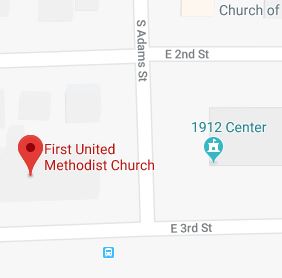
Sunday morning parking at the church is available in the high school parking lot on Third Street across from the church and in the city lots west of the church. These lots are available only on Sunday mornings. A small lot for handicapped parking is available just off of Adams Street on the north side of the church, with an accessible entrance directly into the sanctuary. A lift operates between the Fellowship Hall (3rd Street level) and the Sanctuary. William Sound System Receivers and Headsets are available to assist with hearing problems.
322 East Third Street
Moscow, ID 83843
Church Mission
The First United Methodist Church of Moscow, Idaho takes as our mission to be the body of Jesus Christ, ministering to a community which draws strength from its diversity. Our mission centers on the worship of God, expressed through varied forms of prayer, preaching, music, and ritual. See more...