

Hearing Their Voices - October 14, 2018
A Chorus of Voices (quotes from women in the bible) Let me tell you the story of a woman. She married a man. She loved him. Cooked his meals. Raised his children. And then one day he died. She wasn’t sure what she would do. He had worked. He made the money. She wasn’t allowed. Her place was at home. His family came for the funeral and said they would help. They asked for the money to make the arrangements and made themselves at home in her home. The flood of her grief was intense. But having family there helped. And the day came for the service to say their last goodbyes. And so she did. She said goodbye to her husband, the one who had been her provider and support. And when she returned home, she was told her home was no longer her own. His belongings now belonged to his family, not hers. They returned no money. Gave no
belongings. Just took the rest of what was left of her life as their own.
Do you know her? Maybe you’ve been rummaging in your mind…trying to recall each biblical story you’ve ever heard. Who was she? Who was her husband? Why can’t you place that family?
The sad truth is that as much as we would like to think her story is contained to biblical times. It’s not. She’s a modern woman from Zimbabwe. The details are imagined but the specifics are true. A married woman whose husband died lost all her money, belongings, and their home to his family. And she’s not alone.
Who among us would like to object? That’s not right! That’s not fair! It’s her home. It was their things! She has a right to her belongings!
And you would be right. Zimbabwean law provides for equal property and inheritance rights for men and women. However, many women struggle to claim those rights. Many marriages in Zimbabwe are conducted under customary law and are not registered. Without any official record of the marriage, it is difficult for a widow to claim property that was held in the marriage but formally owned by her late husband.
This is an extreme injustice that calls for change. We can’t just shrug and wish things were different for them. These women need support. They need help. They need to know that they have a legal right to stay in their home and keep their things. And they need to know how to fight against family who tries to take that from them. And we could get all kinds of cranky at the men’s families….but the fact is, it’s not just the in-laws…sometimes it’s the kids too. A woman’s own kids are taking her home from her, claiming their inheritance rights trump hers.
For me, I can look at a situation like this and be filled with frustration and anger. It’s not right! It’s not fair! That’s not how we treat people. And then I wonder how I can take action, and then feel immediately impotent since I’m not there to help, advocate, teach or anything. I’m here. Thousands of miles away. Frustrated and useless to this woman. And from there I have a couple of choices. I can be proud that I saw her and empathized and walk away. I could reach out to her bishop or others in her conference (she is a United Methodist) and see if there are resources they need. Or, maybe the most important, I can see how her problems are not simply hers…limited to Zimbabwe. Her problem is my problem—our problem—for the way women, around the world, and since biblical times and beyond, have been undervalued and mistreated. Our problem because as much as we know things have changed, there’s still so much more to change.
It can feel like too much. It can feel like “if we’ve worked so hard and done so much and it’s still not good enough, then why bother?!” It can be hard to take on big system problems and to fight hard and remain hopeful in the face of so much brokenness. But hope is real. And change is not just possible, but probable if we’re willing to do the work. And real life transformation happens every day.
October 11 is the international day of the girl. As I looked to that day, I was in conversation with friends from Tirzah International—an empowerment agency that works around the globe helping women and girls to have access to education and work that allows them to be free and self-sustaining, particularly in places where they are diminished, abandoned, and forgotten. Tirzah made a special video for the day of the girl. (check our facebook page if you haven’t seen it already). I emailed the director about the video and she emailed back and shared that Menna and her sister are both being helped by Tirzah. That the sister, Amira, who is still a child, was engaged to be married, but has decided she doesn’t want to be engaged to the man (who seemed to maybe not be the best choice for her) and she told her mom she wants to wait to be married. That may seem like a small thing…depending on your perspective, but in a culture where girls marry young and only have a future as wife and mother where education is limited or even denied, that’s a big deal. And it’s possible because she’s been surrounded by people who love her and encourage her for who she is, who help her understand and see possibilities and who are willing to stand beside her to make a difference. Change is possible. Hope is real.
Sometimes I can’t quite wrap my head around the realities others live with. I was raised in a safe home, I was protected from abuse. I was treated as an equal. My brother, sister and I cooked, cleaned, mowed the lawn, and earned allowances in equal measure. Those we saw and learned from were, at least on the surface, treated as equals, men and women alike.
And so when I hear stories of abuse, of mistreatment of misogyny, I am often baffled. I can’t wrap my head around it. It seems unreal that family would take a home away from a recent widow. It seems unbelievable that abuses could happen over and over again and nothing is done about it. That a young teenage girl would be given away without a choice in her own future. I know there are customs and culture and differences, but sometimes I struggle to understand it, to make sense of it. And my danger is to think that because it feels unreal that it is unreal. But it’s not. It’s very real. The brokenness in our world is not simply that which we can run away from or bury our heads from. It’s painful and awful and worthy of our attention. Not so we can be voyeurs or looky-loos but so we can be change agents—people committed to standing up and doing something so that the next generation sees change from ours and knows more clearly, more assuredly that each one, boy and girl, woman and man, are valued equally from birth until death in work and in play.
Current Church News
Get Directions
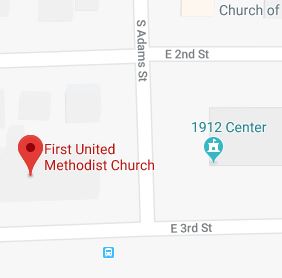
Sunday morning parking at the church is available in the high school parking lot on Third Street across from the church and in the city lots west of the church. These lots are available only on Sunday mornings. A small lot for handicapped parking is available just off of Adams Street on the north side of the church, with an accessible entrance directly into the sanctuary. A lift operates between the Fellowship Hall (3rd Street level) and the Sanctuary. William Sound System Receivers and Headsets are available to assist with hearing problems.
322 East Third Street
Moscow, ID 83843
Church Mission
The First United Methodist Church of Moscow, Idaho takes as our mission to be the body of Jesus Christ, ministering to a community which draws strength from its diversity. Our mission centers on the worship of God, expressed through varied forms of prayer, preaching, music, and ritual. See more...