

What's in a Name? - April 26, 2020
I don’t know about you, but the version of the Lord’s prayer I learned was the King James Version, or maybe the New King James Version, and that’s the one that is in my head and on my heart. I’ve read countless other versions, but this is the one that sticks. So, lucky you, regardless of how you’ve learned it, you get the New King James Version as our starting point. =)
For our series, we’ll be breaking it down into small chunks and focusing on just these small parts as we go along the way—hopefully giving us
greater clarity about how we might pray and gaining value for the words as we say them.
Today our focus verse is, “Our Father who art in heaven, hallowed be thy name.”
Jesus starts his prayer, our prayer, by focusing on God. We aren’t praying into a void. We pray to someone—someone specific—our father. Now it can’t be understated, Jesus says our father. Not just “father in heaven” but “our” father. That’s a big deal. This prayer is for the community. It’s for us—together. It’s not a single person’s solitary prayer. It’s the prayer of the community—of the church. It’s meant for us to pray together, and it’s meant to help us be mindful of one another. Because I can pray it alone, but I don’t change it to “my father who art in heaven”, even by myself, it’s “our father”—even alone, I am reminded that I am part of something bigger. I am part of us and God’s relationship is to us, not just to me, and not just to you, but to all of us.
In this prayer, Jesus calls God “Father”. Now, there’s been a lot of debate over gendered terms for God and God as Father, specifically, we’ll get there, but first, let’s try to look at Jesus’ use and possible intent of the word “Father”.
By calling God “father” Jesus draws attention to their relationship and by extension—to the Trinity. We worship the triune God—Father, Son, and Holy Spirit, or “creator, redeemer, and sustainer.” Three in one. That God came to earth and put on flesh in the person of Jesus of Nazareth and we commonly call that the incarnation. For Jesus to call God, father is to underscore their interconnectedness and relationship and remind us of the incarnation.
The term father also points to the dynamic of fathers and sons in the first century in Israel/Palestine. We know it was a patriarchal culture, and part of that meant that sons followed the path of their father. If dad was a priest, then the son was a priest. If dad was a farmer then the son was a farmer, and if dad was a carpenter than son was a carpenter. Dad modeled the trade, trained his son, and mentored him. The relationship between father and son was one of discipleship, development, and devotion. So for Jesus to call God, father was also to underscore that dynamic.
Now, let’s pause for a moment to dig into some of our struggles. I said at the beginning that some of us struggle with the gendered language and some of us struggle simply with God as Father. Some Christians have said “Oh but we’re not talking about your father” or “Jesus used male language for God so we should use male language.” I’m going to say simply, that’s calloused and unfair.
Jesus is offering us a way of praying that is meant to be life-giving and helpful, and if it’s not, then we need to address that. We need to honor the pain and brokenness in our stories and help empower people to claim what Jesus was offering.
The truth is earthly fathers are not the same as a heavenly father. Human fathers are fallible and broken. Some are incredibly selfish and some are abusive. For many people around the world, their father is not a positive image or influence in their life. And as soon as we liken God to a father, God gets dragged down into the mire of the sins of an earthly father. You can argue they’re not the same until you’re blue in the face, but the reality is we are all bound by the limits of our experience and we will transfer what we know in our lives specifically to God who we may only know vaguely, or at least in limited ways. This would be true if Jesus taught us to pray to God as “teacher.” If all we knew were harsh judgmental teachers, then we would associate God as harsh and judgmental. No, God isn’t that kind of teacher, but if that’s the only kind of teacher I’ve known, then God the teacher will be conflated with the teachers of my past.
So, is God an angry, selfish, abusive father? No. Is God an absentee uninvested father? No. Can we show some compassion and see how “Father God” might get conflated with someone’s earthly experience? I hope so. And we might need to offer some alternative language rather than rubbing people’s faces or faith in the refuse of their past.
Now, our other conunudrum—a male-gendered God. Some folks may say Jesus used gendered language so God must be male. Wrong. Sorry to be so blunt but there is so much more to God than that. We could do a whole series on biblical imagery of God, but we are just going to do the quick and dirty version today.
Starting in Genesis in the creation story, God created male and female “in their image”. That suggests God embodies both female and male in God’s nature. God isn't singularly one or the other. Secondly, God isn’t human. That means God doesn’t have XY, XX, or XXY chromosomes to be identified and sorted. Third, there are other examples, metaphors, and language for God in the Bible that cast God as female—wisdom, also known as Sophia, is female. God is described as a hen who protects her chicks. The list goes on. Fourth, Jesus, just like all of us, was bound to the place and culture he was in While he did plenty to challenge systems and norms, he still had to use language and concepts people could identify with to reach them. The idea of a father who mentored and taught a son was pretty user friendly. Jesus used what was at his disposal, but that doesn’t mean we can’t employ parallel things that are at our disposal.
Now, I want to pause there because I know that some of you are probably reeling. At this point, you’re ready to call the bishop or the heresy police. I get it. We don’t’ want the touchstones of our faith to be messed with and I’m messing with some pretty central things. But I hope you’ll trust me, I’m not trying to defeat the God you’ve always known or the language you’ve always used. I’m trying to challenge all of us to begin to see that God might be even bigger than we thought and our language can adapt to embody the heart of Jesus’ prayer. If it’s uncomfortable for you, that’s ok. Dig into the discomfort. But for others, it might be liberating. If that’s you, know you don’t have to call God Father. You don’t have to believe God is as terrible as your earthly father. You can trust that God is bigger than gender and bigger than what we might understand.
So, all that said, how should we pray? Jesus teaches us to pray “our father”, so don’t we have to use that specific language? Maybe. Maybe not. Remember Jesus pushed on his relationship with God as part of the trinity and how God was a nurturing, mentoring relationship in his life. We should cling to those things. If that means “father God” captures that for you, then use it! If it doesn’t, find something else that might work. Maybe “mother God” or “mentor God” or “teaching God” or “Triune God” “Discipling God” “God of relationship”
The point is not to get locked into a specific language but to get locked into a practice of prayer that orients us first and foremost to the one to whom we pray.
SO, we focus on that God—the good god of creation, of the trinity, of mentoring, development, and mutuality—that God in heaven. In Heaven—bigger and more majestic than what we see or understand on earth. God in heaven who created the universe who is bigger than the cosmos—that God who still is close and near and ready to hear our prayer.
Hallowed be thy name. Hallowed--honored, holy, sacred, and set apart. The third commandment says “thou shalt not take the Lord’s name in vain”. Said another way—you should respect the power of God’s name and use it wisely. We get that same sense here. “Hallowed be thy name” is really about us respecting the power of God’s name. We might better grasp the meaning if we say “help us respect the power of your name and use it wisely.” Or “let us say your name with reverence.”
Are you still with me?! That was a lot packed into one sentence. No wonder Jesus kept it simple!!! Sometimes we have to untie and untangle the parts of scripture that can get us all hung up. If we can’t get through the first line of this prayer, we’ll struggle to move into the next.
For the summary line—the thesis statement at the end of it all—remember this, start by entering your prayer on God. Recognize that God’s name holds power—respect it and use it accordingly—may you claim the God of relationship and mentorship. Amen.
Current Church News
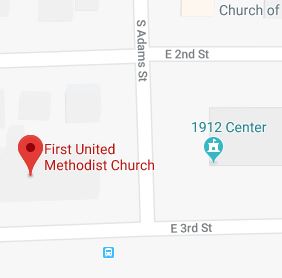
Get Directions
Sunday morning parking at the church is available in the high school parking lot on Third Street across from the church and in the city lots west of the church. These lots are available only on Sunday mornings. A small lot for handicapped parking is available just off of Adams Street on the north side of the church, with an accessible entrance directly into the sanctuary. A lift operates between the Fellowship Hall (3rd Street level) and the Sanctuary. William Sound System Receivers and Headsets are available to assist with hearing problems.
322 East Third Street
Moscow, ID 83843
Church Mission
The First United Methodist Church of Moscow, Idaho takes as our mission to be the body of Jesus Christ, ministering to a community which draws strength from its diversity. Our mission centers on the worship of God, expressed through varied forms of prayer, preaching, music, and ritual. See more...